Home Compostable Loofah: What to Verify Before You Put It on the Label
The packaging proof is approved and the listing copy is almost done. Then someone on the team asks a simple question: can we actually print "compostable" on this?
For years, many eco brands answered that by feel. In 2026, more of them are answering it with documents, because the rules on green claims have tightened in the EU, the US and the UK at the same time. If you sell, or plan to sell, a natural loofah sponge, this guide explains what "home compostable" really means, why buyers and marketplaces now ask for it, and how to label your SKU so the claim holds up.
Short answer: 100% natural loofah is a plant fiber, the dried fruit of the luffa plant, with no foam, binder or plastic in the scrubbing material. That makes it a strong fit for home composting. But "home compostable" is a marketing claim, and regulators expect evidence for the exact product you sell, including thread, fabric backing, labels and packaging. The fiber is the easy part. The finished SKU is what you need to verify.
Home compostable vs. industrially compostable: what is the difference?
Both phrases say the product turns into compost. The difference is where and under what conditions.
- Industrially compostable means the item breaks down in a managed facility that holds high temperatures for a set period. Standards such as EN 13432 are built around those conditions.
- Home compostable means the item breaks down in a backyard bin or garden pile, where temperatures are lower and less stable. Separate certification schemes, such as TUV Austria's OK compost HOME, test for this. A home-compost certificate applies to the specific product that was tested, not to a material in general.
For a shopper, the gap matters. If there is no industrial facility near them, an item that only composts industrially will most likely end up in the trash. That is exactly the situation US guidance asks marketers to disclose.
| Claim on the pack | What the shopper hears | What you should have on file |
|---|---|---|
| "Home compostable" | It breaks down in my own compost | Evidence for home-compost conditions, for the finished product |
| "Industrially compostable" | I need a composting facility | Industrial-compost evidence, plus a note on facility access |
| "Compostable" (no qualifier) | It composts wherever I am | Evidence that covers the conditions most of your customers actually have |
| "Eco-friendly" or "green" | It is better for the planet, in general | In the EU, avoid unless you hold a recognised label such as the EU Ecolabel |
Why are retail buyers asking for proof now?
Three rule sets now point in the same direction: be specific, and be able to prove it.
- EU. Directive (EU) 2024/825, known as the Empowering Consumers Directive, applies from 27 September 2026 with no transition period. It prohibits generic claims like "eco" or "environmentally friendly" unless the trader can show recognised excellent environmental performance, and it bans sustainability labels that are not based on a certification scheme or set by a public authority.
- US. The FTC Green Guides (16 CFR 260.7) say compostable claims need evidence that the item breaks down safely and in a timely manner. A claim should be qualified if the item cannot be composted at home, or if composting facilities are not available to a substantial majority of the consumers or communities where it is sold.
- UK. The CMA's Green Claims Code expects environmental claims to be truthful, clear and backed by evidence.
For a brand, this is a business risk before it is a legal one. A claim that gets challenged can mean relabeling stock, pausing a listing or reprinting packaging in the middle of a season. Getting the wording right before the first production run is far cheaper. (This is general guidance, not legal advice. Check the rules for each market with your compliance advisor.)
Why natural loofah fits a home-compostable product line
Many sponge formats combine several materials. A natural loofah sponge can be close to a single material, which makes the claim simpler to document.
- One plant material in the scrubbing part. The loofah itself is dried plant fiber, with no polyurethane foam and no plastic mesh. Fewer materials means fewer parts to account for in your claim.
- No unnecessary bleaching. WINVN loofah keeps its natural cream to light tan color, and gentle yellowing over time is normal. Leaving out bleaching chemicals gives your team one less input to explain when a retailer asks what is in the product.
- Matured 6+ months, moisture under 12% at packing. A compostable sponge only helps your brand if it reaches the end of its life after use, not in a warehouse. Mature fiber and controlled moisture lower the risk of mold in storage, which is what turns into returns and 1-star reviews.
- Plastic-free packaging options. Kraft boxes and belly bands let the product and the packaging tell the same story on the shelf.
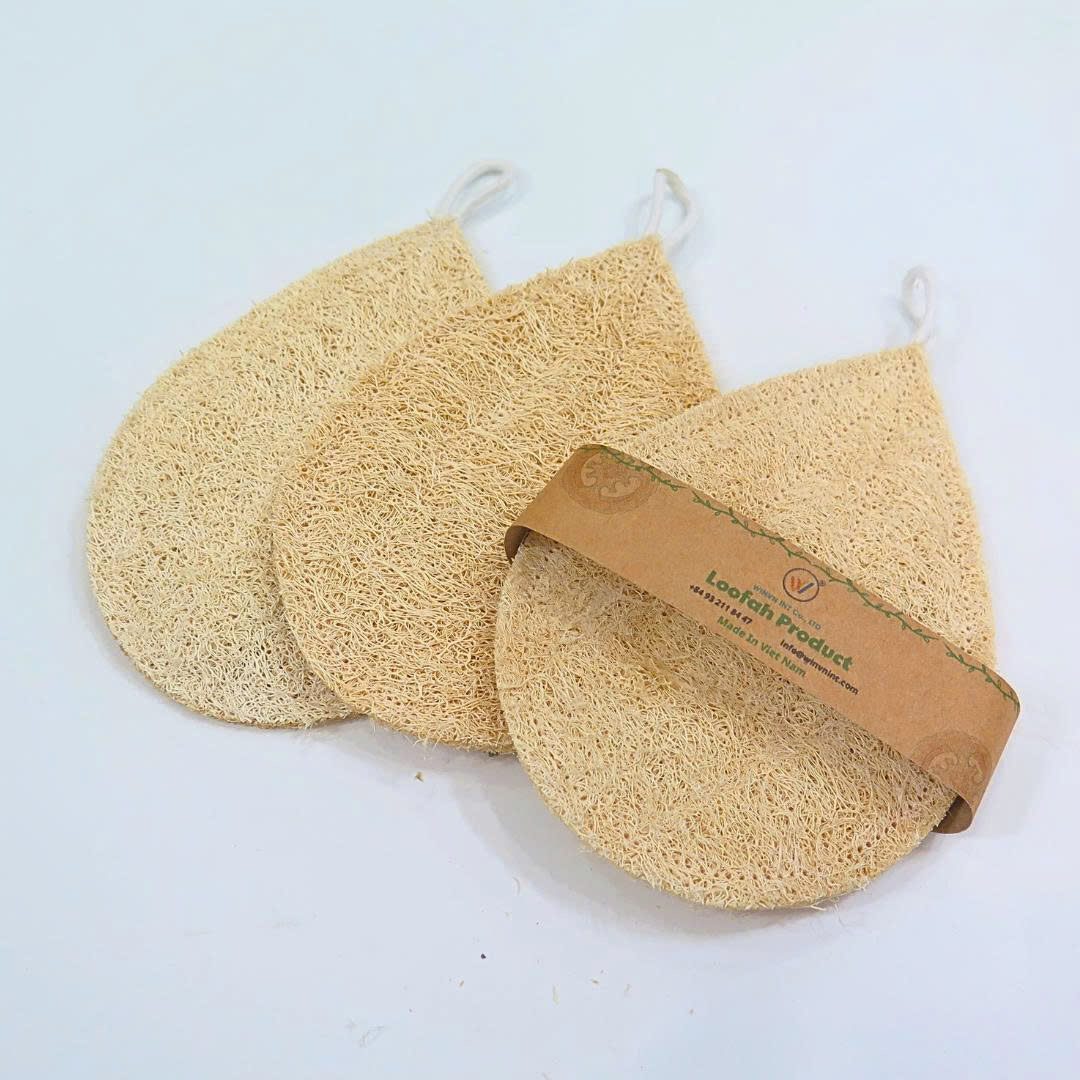
How fast loofah breaks down in compost depends on conditions such as moisture, temperature and piece size, so a fixed number of days is not something any supplier can promise for every home bin. That is one more reason to rely on test evidence rather than a headline figure.
What to check on the finished SKU before you claim "home compostable"
Use this list with your supplier before you sign off artwork.
- Fiber. Confirm in writing that the scrubbing part is 100% loofah with no added coating.
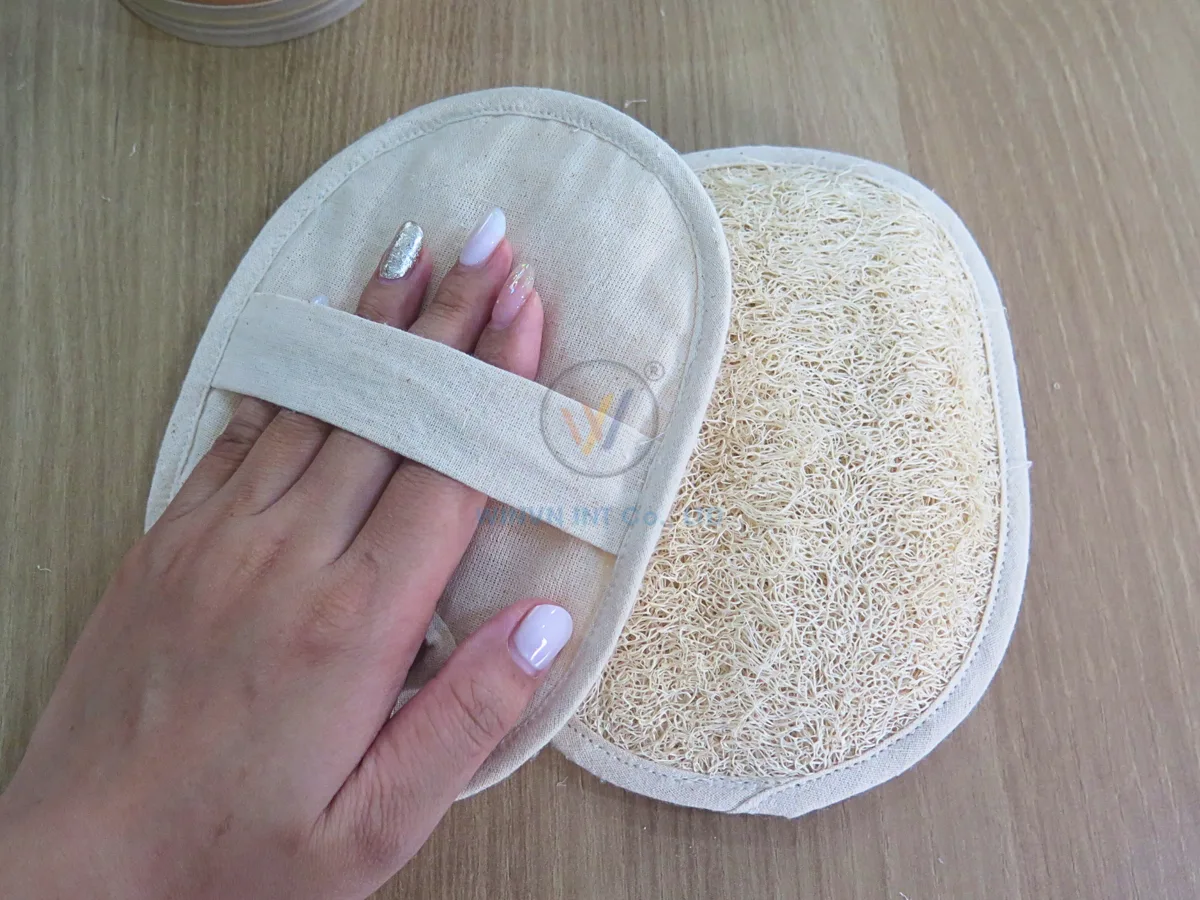
- Secondary materials. List every other part: stitching thread, fabric backing (for example jute on a bath mitt), elastic, hanging loops. Each one is either compostable too, or your disposal instructions tell the customer to remove it.
- Labels and inks. Stickers, laminated tags and glossy inks are often the part that does not compost.
- Packaging. Treat the box as a separate claim. "Compostable product" and "recyclable kraft box" are two different statements that need their own support.
- Evidence that matches the words. If the pack says "home compostable", hold home-compost evidence for that finished product. If you do not have it yet, use a more precise claim (see the table below).
- Disposal instructions. Tell the customer what to do at end of life, in one line. For example: "Remove any non-loofah parts, cut into small pieces and add to your home compost."
Safer claim wording you can use today
| Instead of | Consider |
|---|---|
| "Eco-friendly sponge" | "Plastic-free sponge made from natural loofah fiber" |
| "100% compostable" (without test evidence) | "Made from 100% plant fiber", plus your disposal instruction |
| "Biodegradable" on its own | A specific claim you can support; the FTC treats "biodegradable" as a separate claim with its own evidence standard |
| "Zero waste" | "Plastic-free product and packaging" |
| A self-made green badge | A recognised certification mark, or no badge |
Specific, provable wording also reads as more credible on a listing, because shoppers who care about sustainability are often the same shoppers who read the small print. For the full set of materials claims on a kitchen sponge, see plastic-free kitchen sponge claims you can prove.
How WINVN supports private-label buyers
WINVN supplies natural loofah from Vietnam for eco brands, Amazon sellers and retailers that want a plastic-free bath or kitchen SKU under their own label. For each SKU, we can walk your team through how the product is built (which parts are loofah, which are jute or cotton thread) so your claims match what is actually in the box. Private label and kraft packaging start from a low MOQ of 100 pcs, so you can test a new line without a large first order.
Planning a plastic-free bath or kitchen SKU for 2027? Tell us your product, market and sales channel, and we will send a sample direction along with the construction details your compliance team will ask for.
FAQ
Is natural loofah home compostable?
Pure loofah is a plant fiber with no plastic in the scrubbing material, so it is well suited to home composting. To print "home compostable" on your pack, you still need evidence for the finished product, including any thread, fabric or labels attached to it.
How long does a loofah sponge take to break down?
There is no single number. Speed depends on compost moisture, temperature and piece size, and cutting the sponge into small pieces helps. If you want to state a timeframe on your packaging, base it on a test of your specific product.
What is the difference between home compostable and industrially compostable?
Industrially compostable items need a managed facility with high, sustained temperatures. Home compostable items break down in an ordinary backyard bin or pile. Many shoppers do not have access to an industrial facility, which is why US guidance asks marketers to qualify the claim.
Can I label a loofah sponge "compostable" in the EU?
You can make a specific, substantiated claim. From 27 September 2026, the EU prohibits generic claims such as "eco-friendly" without recognised excellent environmental performance, and bans sustainability labels that are not based on a certification scheme. Check the national rules in each country where you sell.
Does the packaging need its own claim?
Yes. The product and the packaging are separate items. A compostable sponge in a box with a plastic window, for example, needs wording that makes clear which part the claim covers.
Building a plastic-free SKU for 2027?Tell us your product, market and sales channel, and we will send a sample direction with the construction details your compliance team will ask for.
Request a sample →